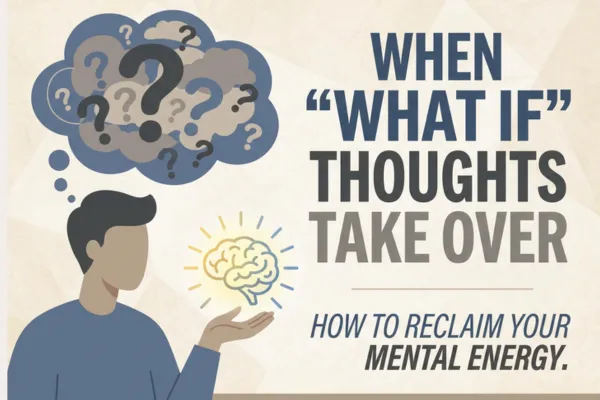
When “What If” Thoughts Take Over: How to Reclaim Your Mental Energy
Have you ever noticed how quickly a single thought can spiral?
You’re about to take a step forward, apply for something, speak up in a meeting, set a boundary, launch an idea and suddenly your mind fills in the blanks:
What if I fail?
What if they don’t understand me?
What if it doesn’t work out?
Nothing has happened yet.
But your body feels like it has.
Your shoulders tighten.
Your breathing shifts.
Your mind starts scanning for proof that it might go wrong.
If that feels familiar, you’re not weak.
You’re human.
And more importantly, your nervous system is doing exactly what it was designed to do.
Why “What Ifs” Feel So Powerful
“What if” thoughts are mental projections. They are your brain attempting to predict outcomes in order to reduce uncertainty.
Your brain does not like uncertainty. It prefers prediction, even negative prediction, over ambiguity. So when you’re stepping into something new, visible, or meaningful, your mind often generates possibilities in advance.

From a nervous-system perspective, this makes sense.
When uncertainty rises, your brain activates threat-detection pathways. It begins scanning for risk. The more attention you give the projection, the more real it feels.
But here’s the key distinction:
“What if” thoughts are not facts. They are rehearsals.
They are simulations, not evidence.
When “What Ifs” Become Traps Instead of Tools
Left unchecked, “what if” spirals can quietly drain mental and emotional energy.

You may notice:
- Increased hesitation
- Over-preparing but never starting
- Avoiding conversations you need to have
- Feeling stuck despite wanting change
Over time, constant mental rehearsal of worst-case scenarios increases cognitive load, the mental effort your brain uses to process, evaluate, and anticipate outcomes.
And cognitive load accumulates.
What starts as a protective thought pattern can gradually become:
Mental fatigue
Irritability
Decision paralysis
Self-doubt
This is how small, dismissible thought patterns connect to larger depletion patterns if left unattended.
Not because you’re incapable.
But because your system has been running contingency planning on repeat.
Normalize This: “What If” Is a Safety Strategy
Before we try to eliminate “what if” thoughts, we need to reframe them.
“What if” thinking is often rooted in:
Past experiences that didn’t go well
Fear of embarrassment or rejection
Desire to maintain control
A strong drive to perform well
For high-functioning adults, especially those used to being responsible and capable, “what if” thoughts often increase when something truly matters.

You care.
You want it to go well.
You don’t want to repeat past pain.
So your brain attempts to protect you by forecasting.
The problem is not that the thought appears.
The problem is when we accept it at face value without evaluation.
How to Make Your “What Ifs” Work for You
Instead of fighting the thought, we build skill around it. This is the type of daily skill-building we practice inside Wellness B.O.S.S., awareness before urgency.
Here are three practical shifts you can begin using immediately.
Skill #1: Write Them Down (Externalize the Loop)
Mental spirals gain power when they stay abstract.
Write every “what if” currently running in your head.

Seeing them on paper:
Reduces mental clutter
Slows the spiral
Activates more rational evaluation pathways in the brain
When thoughts move from internal rumination to visible language, they lose intensity.
You shift from being inside the thought to observing it.
Skill #2: Ask Better Questions
Once you list the “what ifs,” ask:
What is this thought really trying to protect me from?
Is this based on current evidence or past experience?
If this happened, what would I actually do?
Often, the fear beneath the projection is manageable.
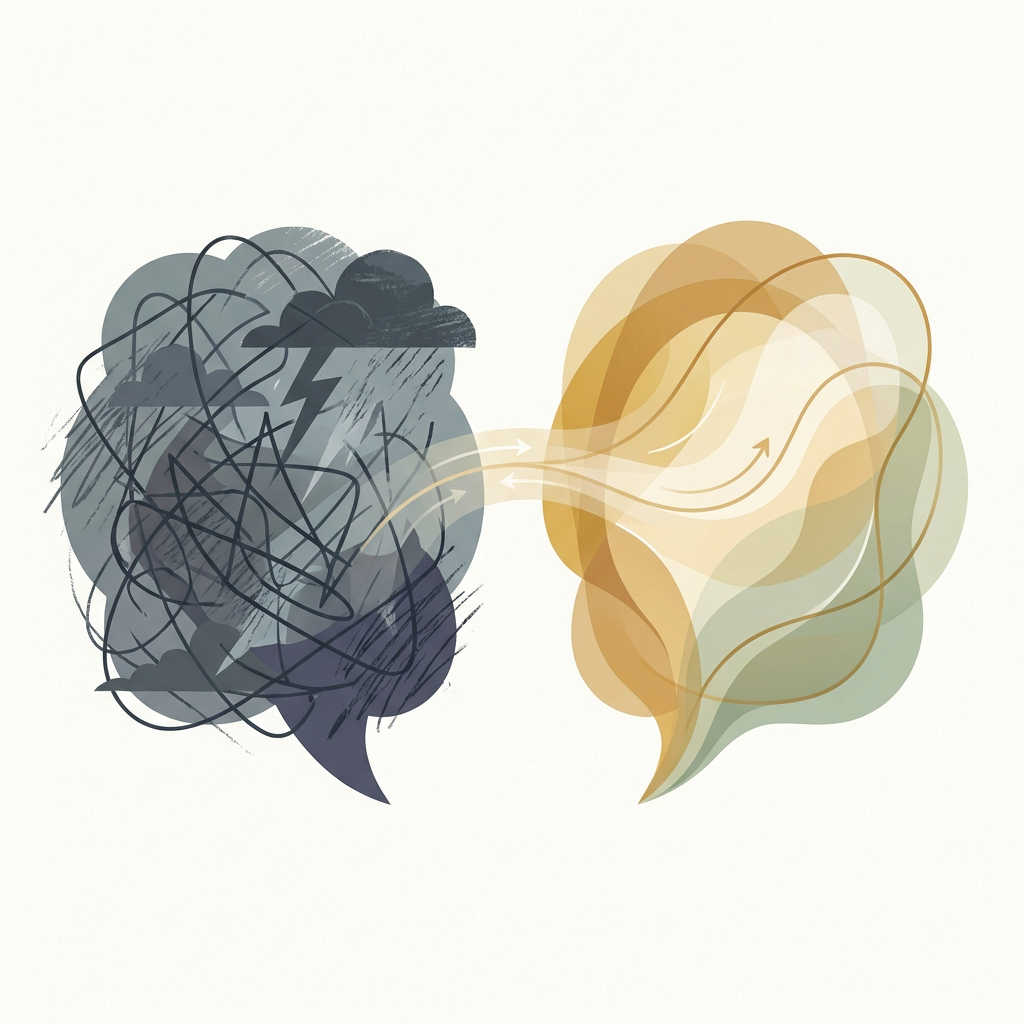
Instead of:
“What if I fail?”
Try:
“What would failure actually mean and what would I do next?”
That subtle shift restores agency.
Skill #3: Support the Step, Not Just the Fear
Many “what if” thoughts are attempts to seek safety.
Rather than eliminating the thought, increase the support around your next action.

Ask:
Do I need more preparation?
Do I need a conversation?
Do I need reassurance?
Do I need to scale the step smaller?
When you increase structure, clarity, and support, the fear naturally reduces.
Confidence is rarely the starting point.
Support is.
Reflection Questions (Insight, Not Judgment)
Take a few quiet minutes with these:

1. What “what if” thoughts have been repeating lately?
2. What are they really rooted in (fear of failure, past pain, uncertainty about your worth)?
3. How could each “what if” become preparation instead of paralysis?
4. What support would help you feel steadier taking your next step?
Awareness is the beginning of recalibration.
From Hesitation to Intention
Your “what ifs” don’t have to be roadblocks.
They can become signals:
That you’re stepping into growth
That something matters to you
That you’re expanding beyond your comfort zone
When you face those thoughts with intention instead of avoidance, something shifts.

Hesitation becomes evaluation.
Evaluation becomes preparation.
Preparation becomes forward movement.
You don’t eliminate fear by force.
You build capacity around it.
And capacity is a skill.
The more consistently you practice noticing, reframing, and supporting your next step, the steadier you become, not because uncertainty disappears, but because your response strengthens.
This is how we build mental and emotional strength the same way we build physical strength: through small, repeated adjustments over time.
You’ve got this.


