Co-Parenting and Divorce Recovery: Holding the Emotional and Practical Sides Together
Co-parenting and divorce recovery cover two connected experiences. The emotional work of moving through a divorce or separation. And, for parents, the ongoing work of building a functional co-parenting relationship afterward. Both involve real grief and real logistics. Both involve real decisions that keep needing to be made, even while the emotional side is still settling.
Divorce is often treated as a single event with a before and after. In practice, it is closer to an ongoing transition. It keeps asking something new of a person for months. Sometimes longer, long after the paperwork itself is finished.
This is one of the most searched wellness topics for good reason. It sits at the intersection of grief, identity, and finances. For many people, it also touches an ongoing parenting relationship. That relationship has to keep functioning even while everything else is still settling. Few life transitions ask this much of so many parts of a person's life at once.
How This Transition Shows Up in Everyday Life
Divorce and co-parenting bring a specific, recognizable set of experiences, even though every situation looks different on the surface. Common patterns include:
•Feeling grief, anger, and relief within the same day, sometimes within the same conversation
•Old relationship patterns resurfacing during a simple logistics conversation about a shared schedule
•Tension between wanting to protect your child and not being sure what protecting them actually looks like right now
•A sense that this chapter ending means something has gone permanently wrong, when it has simply ended
•Rebuilding a daily routine and structure that used to run on two people, now running on one

These experiences are common because divorce touches so many parts of life at once. Identity, daily logistics, finances. For parents, an ongoing relationship with a former partner that still has to function well enough for a child.
This is why divorce can feel exhausting even on an ordinary day. There is rarely just one thing to manage. There are several, all at once, and they do not take turns.
A person can feel steady about the finances and still feel raw about the loss on the very same afternoon. Neither feeling cancels the other one out.
The Challenge With General Support Alone
Most advice on divorce focuses on one piece at a time. Process the grief. Get legal advice. Set a custody schedule. Each piece is genuinely necessary. Taken separately, none of them show how the pieces interact. Unresolved grief can surface in a custody conversation. A business-like coparenting script can coexist with real emotional loss underneath it.
Design Life Hub calls this fragmented wellness. It means real, useful pieces of support, like a therapist for the grief and an attorney for the logistics. Neither one offers a structure for holding both sides together. Working through them in the right order takes something more.
Each professional involved is genuinely good at their part. A therapist is not typically positioned to help with a custody schedule. An attorney is not the right person to process grief with. The gap sits between the professionals, in the everyday moments where both sides show up at once.
A person can process grief in therapy and still feel unprepared for a tense co-parenting conversation the very next day. Grief work and coparenting skills were never connected into one plan. Each piece was addressed. The transition as a whole was not.
A Small Step Toward a Sustaining Practice
One way to start is a short weekly check-in with yourself, not your former partner. Cover three questions: what feels heaviest this week, what logistics need attention, and what is one thing you did to care for yourself. Write brief, honest answers, even a few words each.
Separating the emotional weight from the practical logistics, on paper, once a week, keeps the two from blurring together. That blurring is what makes every conversation with a former partner feel emotionally loaded. It also gives you a clear, current record of what actually needs support, whether that is a conversation with a friend, a therapist, or simply rest.

Over a few weeks, this record also becomes something to look back on. A heaviness that shows up every week around the same logistics conversation is worth naming specifically. It is worth bringing into a conversation with a therapist or a co-parenting script built for exactly that kind of moment.
How Design Life Hub Helps You Build a Customized Practice
Design Life Hub's resources take that kind of honest weekly check-in and turn it into a sustaining, guided practice. The goal is not generic advice to take care of yourself or process your feelings. It is a structured path through both the emotional and practical sides of this transition, built for exactly where you are in it.
That structure matters because this transition does not resolve on a fixed timeline. The support that helps most in the first month, stabilizing daily routine, often looks different from what helps most a year later. By then, the focus has shifted toward the next chapter. A guided kit built around stages, not a single moment, keeps pace with wherever you currently are.
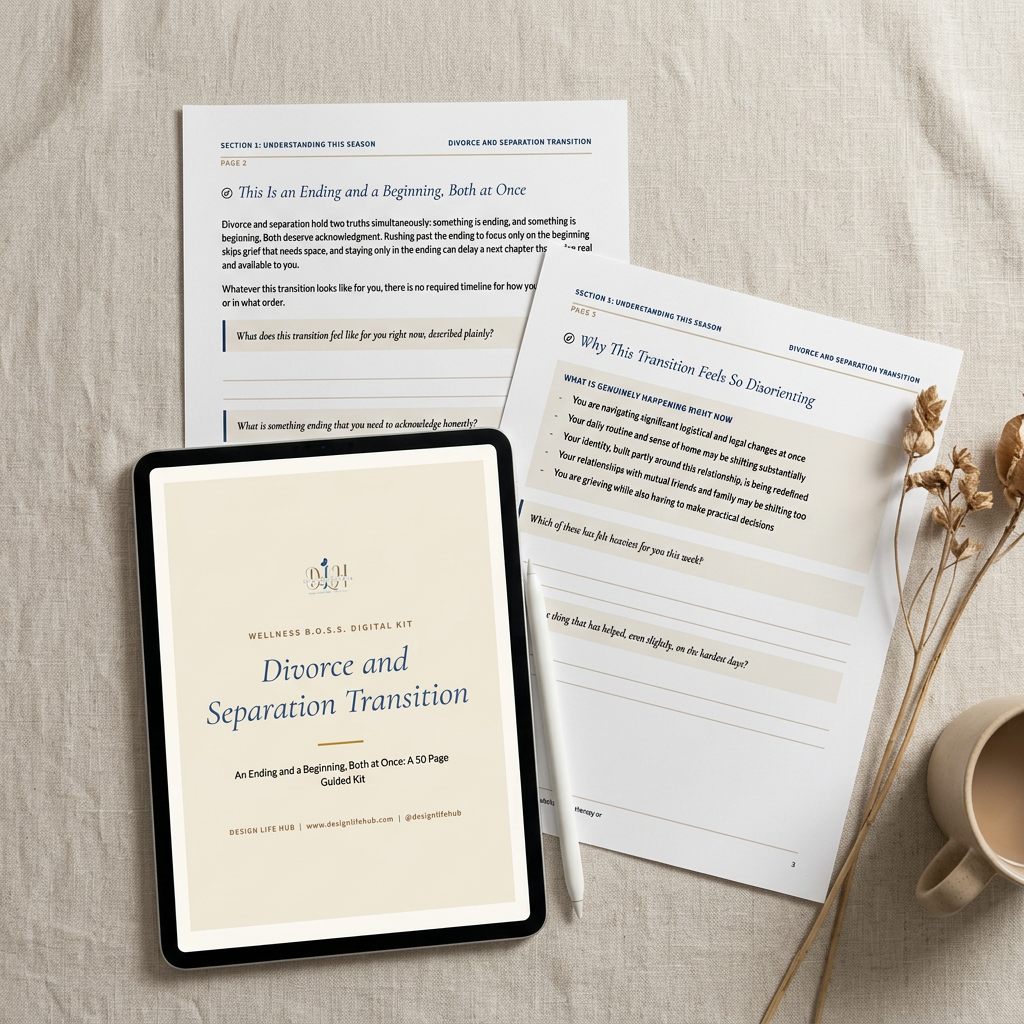
Divorce and Separation Transition is a guided digital kit built for anyone navigating divorce or separation, at any stage. It moves through an honest emotional wellness check naming grief, anger, and relief. Mindset work that directly rejects the idea that divorce equals personal failure. Guided reflective journaling.
Communication scripts for a former partner, children, and family. Self-care built around rebuilding daily structure. It closes with a 30-day stabilization plan and a vision for the next chapter.
For parents specifically, Co-Parenting After Separation offers a focused companion. It reframes co-parenting as its own distinct relationship, with business-like communication scripts for handling disagreements and schedule changes, and a 30-day co-parenting improvement plan centered on your child's wellbeing.
This content is educational. It is not a replacement for support from a licensed provider, attorney, or mediator. It is a place to start, or a practice to continue alongside professional support.
Explore Your Next Step: start Divorce and Separation Transition today.